HapticGen
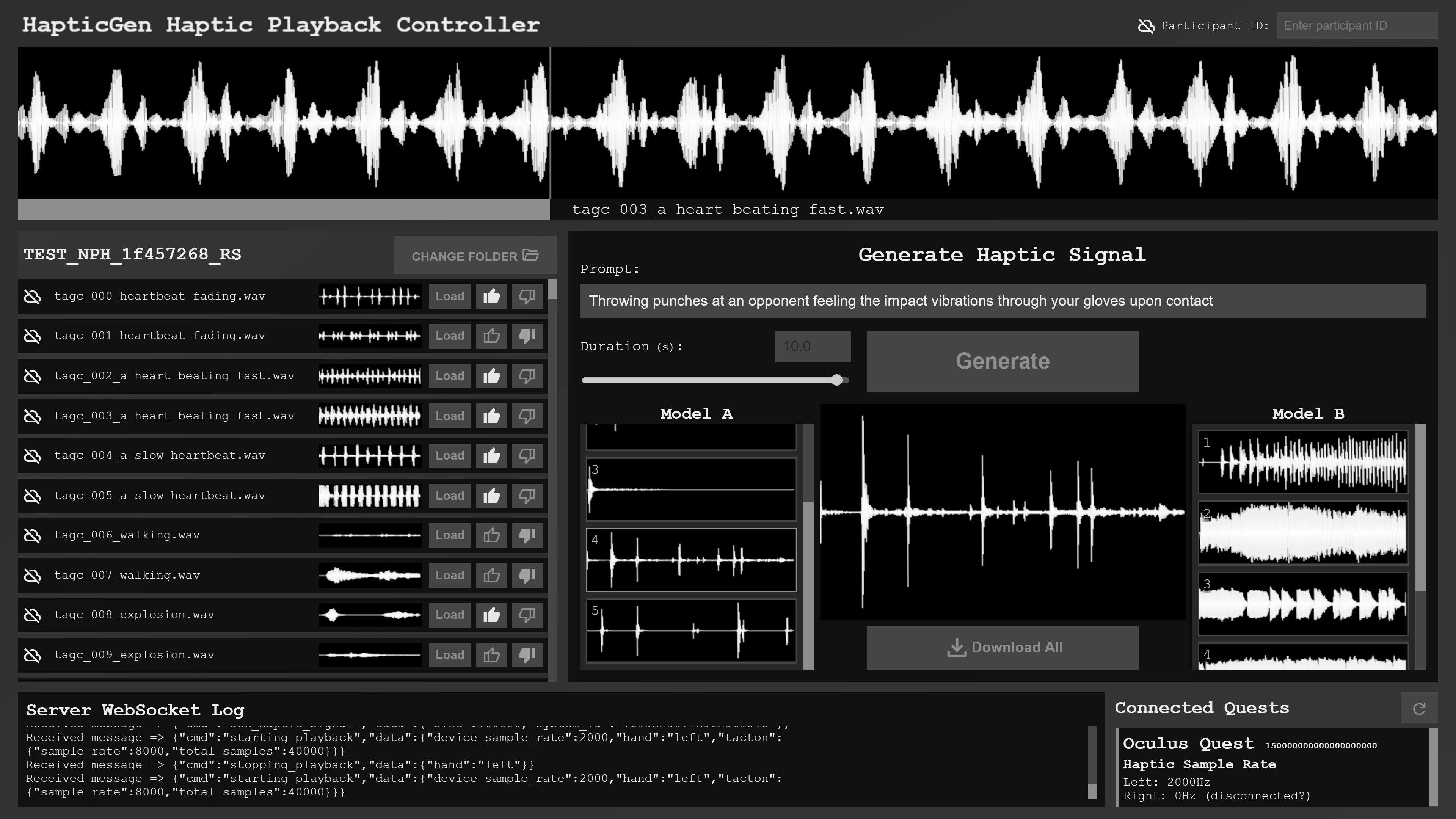
Tool Summary
| Metadata | |
|---|---|
| Release Yearⓘ The year a tool was first publicly released or discussed in an academic paper. | 2025 |
| Platformⓘ The OS or software framework needed to run the tool. | Python |
| Availabilityⓘ If the tool can be obtained by the public. | Available |
| Licenseⓘ Tye type of license applied to the tool. | Open Source (MIT) |
| Venueⓘ The venue(s) for publications. | ACM CHI |
| Intended Use Caseⓘ The primary purposes for which the tool was developed. | Prototyping |
| Hardware Information | |
|---|---|
| Categoryⓘ The general types of haptic output devices controlled by the tool. | Vibrotactile |
| Abstractionⓘ How broad the type of hardware support is for a tool.
| Consumer |
| Device Namesⓘ The hardware supported by the tool. This may be incomplete. | Meta Quest |
| Device Templateⓘ Whether support can be easily extended to new types of devices. | No |
| Body Positionⓘ Parts of the body where stimuli are felt, if the tool explicitly shows this. | N/A |
| Interaction Information | |
|---|---|
| Driving Featureⓘ If haptic content is controlled over time, by other actions, or both. | Time |
| Effect Localizationⓘ How the desired location of stimuli is mapped to the device.
| Device-centric |
| Non-Haptic Mediaⓘ Support for non-haptic media in the workspace, even if just to aid in manual synchronization. | None |
| Iterative Playbackⓘ If haptic effects can be played back from the tool to aid in the design process. | Yes |
| Design Approachesⓘ Broadly, the methods available to create a desired effect.
| Procedural, Description |
| UI Metaphorsⓘ Common UI metaphors that define how a user interacts with a tool.
| None |
| Storageⓘ How data is stored for import/export or internally to the software. | WAV |
| Connectivityⓘ How the tool can be extended to support new data, devices, and software. | None |
Additional Information
HapticGen uses a modified version of Meta’s AudioCraft project to generate haptic waveforms from user-specified prompts. The AudioCraft model was fine-tuned using a haptic dataset created automatically from an existing text-to-audio dataset that was then curated by expert participants. In the design interface, the duration of a desired effect can be specified by the user, but other aspects of it are left entirely to the model.
For more information, consult the CHI’25 paper and the GitHub repository.